



Recently, I have immersed myself in a captivating exploration of Alchemy through various books, and this endeavour has revealed to me the remarkable significance that Alchemy holds in the historical tapestry of chemistry, a significance I had previously underestimated. My earlier misconceptions about Alchemy were, in part, framed by its portrayal in popular culture and by prevailing narratives in the fields of history and philosophy of science, which often regarded Alchemy as little more than a precursor to modern chemistry, complete with its quaint and fantastical notions.
Recently, I have immersed myself in a captivating exploration of Alchemy through various books, and this endeavour has revealed to me the remarkable significance that Alchemy holds in the historical tapestry of chemistry, a significance I had previously underestimated. My earlier misconceptions about Alchemy were, in part, framed by its portrayal in popular culture and by prevailing narratives in the fields of history and philosophy of science, which often regarded Alchemy as little more than a precursor to modern chemistry, complete with its quaint and fantastical notions.
To be fair, it is true that Alchemists, at times, cloaked their practices in a veil of obscurity and esoteric language, rendering their work inaccessible to those outside their inner circles. This deliberate obfuscation served a dual purpose: it not only obscured precise details of their methodologies but also enhanced their aura of mystery and authority. The alchemists’ reputation hinged on the belief that they could deliver miraculous solutions, universal panaceas that promised to cure ailments and provide practical remedies for the everyday troubles of life.

In their ventures, they crafted grand theories, ambitious in scope, attempting to weave together and explain a vast array of phenomena, from chemical reactions to the celestial ballet of the planets, the intricate workings of the human body, and humanity’s relationship with the divine. Prominent figures in this mystical tradition, such as the goddess Isis, the legendary Hermes Trismegistus, and Miriam, the sister of Moses, were revered as pivotal Alchemical figures, further contributing to Alchemy’s legendary and often mythical aura. Such narratives understandably invited scepticism and led to grandiose claims that now seem incredible, reducing Alchemy to a mere artefact of misconception and romantic fantasy.
Yet, despite its waning glamour, Alchemy conceals a treasure trove of insights that beckon modern inquiry, offering the possibility of a renewed appreciation for its contributions to contemporary science. Consider the questions that alchemists posed and the theories they devised; they were not as far-fetched as we may perceive them today through a 21st-century lens. Before the dawn of the Scientific Revolution, it was the norm to construct comprehensive worldviews claiming to explain all aspects of existence. Aristotle and other eminent figures from antiquity played key roles in this philosophical tradition, straddling the fields of science, metaphysics, and the natural world. The precision and compartmentalisation of science as we know it, a distinctly organised enterprise with explicit roles, responsibilities and methodologies, emerged only during and after the Scientific Revolution.
Moreover, when we examine the Alchemical quest for a substance capable of transmuting base metals into gold, most famously epitomised by the elusive Elixir of Life or the Philosopher’s Stone, we begin to see the rational undertones of what may initially seem like irrational pursuits. Observers of nature routinely witnessed one metal morphing into another and experienced significant transformations in materials when combined in particular ways. Given this empirical foundation, why would it seem so unreasonable to ponder the possibility of artificial gold creation? This line of reasoning resonates with modern discussions; Philip Ball, for instance, explores similar themes by referencing contemporary achievements aimed at metal transmutation.
As I delve deeper into my studies, I am increasingly captivated by the rich tapestry of Alchemical thought, recognising it as a vital precursor to modern scientific inquiry. The Alchemists were not merely dreamers; they were early innovators grappling with the mysteries of the natural world in a time when the boundaries of knowledge were yet to be delineated. Thus, I invite you to join me in uncovering the exciting and often surprising legacies of Alchemy, appreciating its foundational role in the evolution of scientific thought as we know it today.

Alchemists cultivated a methodology strikingly similar to the practices of contemporary scientists conducting chemistry today. To truly appreciate the rich tapestry of scientific history, it is essential to challenge the often misguided perceptions surrounding Alchemy. A significant portion of the negative reputation we associate with Alchemy can be traced back to the deliberate efforts of prominent chemists and influential thinkers, including figures such as René Descartes, who sought to distance themselves from this ancient practice. Robert Boyle stands out as a quintessential example of this tendency. In his quest to establish his own credibility and separate his work distinctly from that of Alchemists, Boyle engaged in a public campaign that painted Alchemists in an unfavourable light. However, this portrayal is paradoxical, given that many of Boyle’s own contributions to chemistry were rooted in, or directly inspired by, the substantial body of work established by Alchemists, work that he often failed to acknowledge.
In recent scholarship, there has been a concerted effort to reassess the contributions of Alchemy to the broader narrative of chemistry and science. Historians such as William Newman and Lawrence Principe have illuminated how Alchemical practice was grounded in empirical observation and experimentation. They present compelling evidence of alchemical recipes that showcase remarkable clarity and precision, revealing methods that closely parallel the rigorous techniques employed by modern chemists. This alignment suggests that Alchemy was not merely a mystical pursuit but rather a precursor to scientific inquiry, with a focus on systematic investigation of the natural world.
Moreover, it is crucial to highlight the significant role played by female Alchemists throughout history, a contribution that is often overshadowed or ignored in traditional narratives. In an era when women’s contributions to science were typically marginalised, it is noteworthy that some female Alchemists received respect and recognition from their male counterparts. One such figure is Mary the Jewess, who was acknowledged by the renowned alchemist Zosimos of Panopolis during the 3rd to 4th century CE. Although her writings have not survived through the ages, her legacy endures through the acknowledgment she received from contemporaries, demonstrating that women were integral to the evolution of Alchemical thought.
Ultimately, Alchemy has laid essential foundations for modern chemistry, encompassing significant discoveries of elements and the invention of crucial chemical apparatuses. To disregard or undervalue these contributions would be a disservice not only to the history of science but also to our understanding of how contemporary chemistry has evolved. Therefore, it is imperative that we re-evaluate Alchemy’s historical significance, recognising its rich legacy and influence on the scientific advancements we often take for granted today.

Famous Alchemists – The Pioneers of Transformation & Knowledge
Alchemy, often viewed as a precursor to modern chemistry, is a fascinating blend of science, philosophy, and art that seeks to transform base materials into noble ones, most famously the pursuit of turning lead into gold. Historically, it has attracted some of the brightest minds spanning ancient civilisations to the Renaissance and beyond. In this paragraph we will have a closer look at the lives and legacies of famous Alchemists, exploring their contributions and the lasting impact they had on science, philosophy, and culture.
The Origins of Alchemy
Alchemy is believed to have begun in ancient Egypt and Greece. The word itself is derived from the Arabic term “al-kīmiyā,” which refers to the “art of transformation.” Ancient practitioners combined spiritual, mystical, and physical elements to explore the nature of substances and the universe. The goals of Alchemy included the transmutation of metals, the creation of the Philosopher’s Stone, and the pursuit of the Elixir of Life, which promised immortality. As Alchemy spread through cultures, it evolved, absorbing ideas from Indian, Chinese, and Islamic traditions. Each region contributed its philosophies and methodologies, allowing alchemy to flourish during the medieval period and the Renaissance.
Pioneering Alchemists
Hermes Trismegistus: A legendary figure, Hermes Trismegistus, is often considered the father of Alchemy. His existence is believed to be a syncretic amalgamation of the Greek god Hermes and the Egyptian god Thoth. Hermes is credited with writing the Emerald Tablet, a foundational alchemical text that encapsulates the essence of Alchemical philosophy with the famous phrase, “As above, so below.” This principle suggests that the microcosm (human beings) reflects the macrocosm (the universe), creating a connection between the two.
Geber (Jabir ibn Hayyan): Regarded as the “father of chemistry,” Jabir ibn Hayyan, known as Geber in the Latinised form, was an 8th-century Persian Alchemist who made significant contributions to the field. His work encapsulated the methodologies of experimentation and observation, moving beyond theoretical musings. Geber’s writings on Alchemical processes and substances, including the use of acids and the discovery of various chemical compounds, laid the groundwork for modern chemistry. His texts introduced concepts such as distillation and crystallisation.
Nicolas Flamel: Perhaps the most famous Alchemist in popular culture, Nicolas Flamel, is often associated with the quest for the Philosopher’s Stone and the Elixir of Life. A French scribe and philanthropist from the 14th century, he gained notoriety through various legends, especially after his death, that he had achieved the transformation of metals and attained immortality. Although many of his Alchemical texts are now considered pseudepigrapha (spurious or pseudonymous writings), Flamel’s legacy endures in literature and film, notably as a character in J.K. Rowling’s Harry Potter series.
Paracelsus: Paracelsus, born Theophrastus von Hohenheim in the 16th century, was a Swiss physician and Alchemist who challenged traditional medical practices of his time. He believed that disease was caused by external factors rather than imbalances of bodily humours. Paracelsus introduced the concept of using chemicals and minerals in healing, which would later evolve into the field of toxicology. His emphasis on observation and experience marked the beginning of modern medicine and alchemy’s transition toward empirical science.
Isaac Newton: While primarily known for his contributions to physics and mathematics, Isaac Newton had a profound interest in Alchemy, devoting a substantial part of his life to its study. Newton’s Alchemical writings and experiments reveal a deep fascination with the transformation of matter. He explored the principles underlying transmutation and the nature of substances, though many of his ideas were not recognised in his lifetime. His Alchemical work remained largely hidden until centuries later, but it significantly influenced his scientific theories.
Michael Sendivogius: Michael Sendivogius, a Polish alchemist of the Renaissance, is often credited with the discovery of phosphorus. He was a proponent of the idea that air contains vital elements necessary for the transmutation of metals. Sendivogius’s belief in the spiritual aspects of Alchemy intertwined with his scientific inquiries, positioning him as a bridge between medieval thought and modern chemistry.
Robert Boyle: Best known for Boyle’s Law in gas physics, Robert Boyle also contributed extensively to Alchemy and chemistry. In the 17th century, Boyle emphasised the role of experimentation and the scientific method in Alchemical practice. He argued for the need to distinguish between ‘chymistry’ (Alchemy) and other philosophical branches. His book, The Sceptical Chymist, rejects the traditional elements of fire, earth, air, and water, advocating instead for a more modern understanding of chemical substances based on their composition and properties. In this work, Boyle challenged the classical notion of elements and proposed that substances should be understood through empirical observation and experimentation rather than through speculative philosophy. He introduced the idea that matter is composed of particles that can combine in various ways to form different substances. Boyle’s emphasis on rigorous experimentation laid the groundwork for modern chemistry and the scientific method. He advocated for systematic investigation and quantifiable results, which was a significant departure from the more mystical and speculative practices of traditional Alchemy. His contributions helped to shift Alchemy toward a more empirical and systematic discipline, ultimately leading to the development of modern chemistry. In addition to his work in chemistry, Boyle was also known for his writings on physics, particularly his studies in gas behaviour, which culminated in Boyle’s Law. This law describes the relationship between the pressure and volume of a gas at constant temperature, illustrating the inverse relationship between the two. Overall, Robert Boyle’s influence on the scientific community was profound, and his insistence on experimentation and scepticism laid a foundational principle for future scientific inquiry. His legacy continues to be felt in both chemistry and the broader scientific method.

Main Achievements by Alchemists
While often associated with the quest to turn base metals into gold or discover the elusive Philosopher’s Stone, Alchemy’s achievements extend far beyond these mystical aspirations. This paragraph explores the most significant contributions and breakthroughs made by Alchemists throughout history, providing insight into their enduring legacy.
The Birth of Modern Chemistry
Though many of the practices and theories of Alchemy may appear out-dated or esoteric today, Alchemy laid the groundwork for modern chemistry. Alchemists were among the first to conduct systematic experiments and carefully document their processes. They established principles of observation and experimentation, key components of the scientific method.
Early Scientific Methods: Alchemical texts often included detailed descriptions of procedures and observations, which later historians acknowledged as precursors to laboratory practices. Figures such as Jabir ibn Hayyan (Geber), considered the father of chemistry, developed qualitative analysis and introduced the concept of quantification.
Substances & Transmutation: Alchemists investigated the nature of substances, contributing to early knowledge of chemical reactions. They posited that matter could change forms, a concept that would be refined in modern chemistry through the understanding of chemical reactions and the conservation of mass.
Discovery of Elements & Compounds
Alchemists contributed to the discovery and understanding of various substances that would later be classified as elements or compounds. Their work led to the identification of several essential materials.
Elements: While Alchemists did not classify elements in the modern sense, they identified and experimented with substances that we now recognise as key elements. For instance, they isolated several metallic compounds, and the work of Alchemist Robert Boyle in the 17th century laid the groundwork for the identification of elements like hydrogen and oxygen.
Acids & Bases: Alchemy provided early insights into acidic and basic substances. Alchemists created many notable acids, including sulphuric acid and nitric acid, and explored their properties. Such contributions paved the way for a deeper understanding of acidic and basic reactions in chemistry.

Techniques &
The practical techniques developed by Alchemists significantly advanced the art of laboratory work.
Distillation: One of the most significant achievements of Alchemy, distillation, emerged as a method for separating mixtures based on differing boiling points. This technique is fundamental today in various fields such as chemistry, pharmacology, and petrochemicals.
Filtration & Sublimation: Alchemists also developed processes such as filtration and sublimation, expanding the arsenal of techniques available for purifying substances and studying their properties. The use of apparatus like alembics, crucibles, and retorts set the stage for modern laboratory equipment.
Medicine & Pharmacology
Alchemy played a crucial role in the early development of medicine and pharmacology. Many Alchemists pursued the creation of elixirs, tonics, and medicines, ensuring a legacy of healing through empirical experiments.
Medicinal Elixirs: Al chemists sought to create potions that could heal ailments or prolong life. Although not scientifically valid by today’s standards, their achievements expanded the understanding of herbal properties, leading to the development of early pharmacology.
Paracelsus & Chemical Medicine: Paracelsus, a significant figure in Alchemical medicine, emphasised the importance of chemical substances in healing. He argued that disease resulted from chemical imbalances, and his approach laid the foundation for the use of chemical compounds in treating illnesses, a pivotal moment in medical history.
Philosophical & Spiritual Contributions: Alchemy was not solely a scientific pursuit; it was also deeply intertwined with philosophy and spirituality. Alchemists sought to understand the universe’s fundamental truths, leading to ground-breaking philosophical discourse.
Transmutation of the Soul: Alchemy was as much about personal transformation as it was about material change. Alchemists viewed their work as a path to enlightenment, believing that the process of transforming metals paralleled the journey of self-improvement and spiritual evolution.
Hermetic Philosophy: The Hermetic tradition, rooted in Alchemical symbolism, contributed significantly to Western esoteric thought. The writings attributed to Hermes Trismegistus influenced not only Alchemical practices but also general philosophical ideas about the interconnectedness of all things.
Historical & Cultural Impact
The impact of Alchemy has transcended scientific fields, influencing art, literature, and cultural thought throughout history.
Art & Literature: Themes and symbolism from Alchemy have inspired countless works of art and literature, from the Renaissance to modern times. Artists such as Salvador Dalí channeled Alchemical motifs, while writers like Goethe explored Alchemical themes in their poetry.
Mysticism & Secret Societies: Alchemy has often been intertwined with mysticism, serving as a bridge between the physical and spiritual worlds. Many Alchemists viewed their work as a path to spiritual enlightenment, believing that the transformation of base metals into gold mirrored an inner transformation of the soul. This esoteric approach led to the formation of various secret societies and mystical groups, such as the Rosicrucians and the Freemasons, which sought to preserve and disseminate Alchemical knowledge. These societies often employed symbolism and allegory rooted in alchemical practices to convey deeper philosophical and spiritual truths, contributing to the rich tapestry of Western mystical traditions.
Cultural Thought: Alchemy’s influence can also be seen in broader cultural thought, particularly in the fields of psychology and philosophy. Carl Jung, one of the most prominent figures in modern psychology, drew heavily on Alchemical symbolism to articulate his theories of the psyche. He interpreted the Alchemical process not merely as a physical transformation but as a metaphor for psychological growth, self-realisation, and individuation. Jung’s analysis highlights how Alchemical concepts have permeated the understanding of human consciousness, illustrating their relevance beyond scientific inquiry. Alchemy’s historical narrative is further enriched by its ability to shape cultural paradigms, reiterating humanity’s quest for knowledge, transformation, and the quest for deeper understanding of both the material and spiritual worlds. As such, the legacy of Alchemy remains a testament to the interconnectedness of science, philosophy, and the arts in the on-going evolution of human thought.
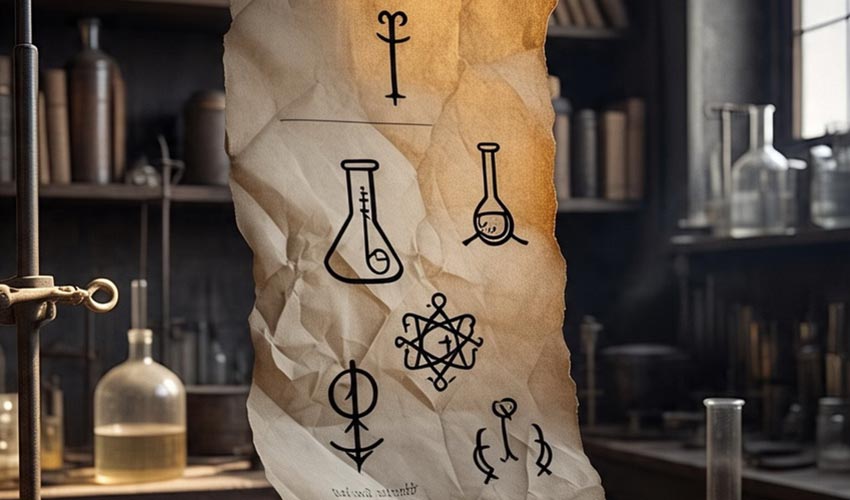
Specific Symbols for the Seven Classic Metals in Alchemy
In Alchemy, each metal was associated with specific symbols that represented its properties and characteristics. Here are the symbols for the seven classical metals commonly referenced in alchemical texts:
- Gold (Aurum) – ☉ (a circle with a dot in the centre)
- Silver (Argentum) – ☽ (a crescent moon)
- Mercury (Hydrargyrum) – ☿ (the planet Mercury symbol, which looks like a circle with a cross beneath it)
- Copper (Cuprum) – ♀ (the symbol for Venus, similar to a hand mirror)
- Iron (Ferrum) – ♂ (the symbol for Mars, resembling a circle with an arrow pointing upward)
- Tin (Stannum) – ♃ (the symbol for Jupiter, depicting a stylized ‘4’ with an added tail)
- Lead (Plumbum) – ♄ (the symbol for Saturn, resembling a cross and a semicircle)
“The Hero’s Journey is, in the final analysis, the shaman’s, the alchemist’s, the wizard’s—and it’s all about energy.” – Sol Luckman, Get Out of Here Alive: Inner Alchemy & Immortality


