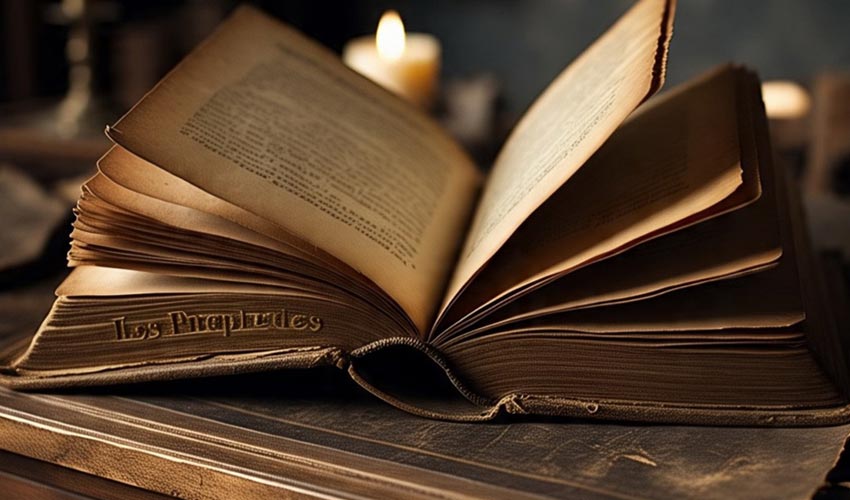
It was nearly a quarter of a century ago when I first stumbled upon a legendary tome at my local library, Nostradamus’ renowned compilation, “The Prophecies.” Originally published in 1555, this enigmatic work captured my imagination like no other. Even now, years later, I find myself drawn back to the profound mysteries contained within its pages. Today, I am excited to delve into the life and legacy of the man behind this monumental text: the French astrologer and physician known as Nostradamus.
It was nearly a quarter of a century ago when I first stumbled upon a legendary tome at my local library, Nostradamus’ renowned compilation, “The Prophecies.” Originally published in 1555, this enigmatic work captured my imagination like no other. Even now, years later, I find myself drawn back to the profound mysteries contained within its pages. Today, I am excited to delve into the life and legacy of the man behind this monumental text: the French astrologer and physician known as Nostradamus. Join me as we explore the captivating world of a visionary who dared to gaze into the future and left an indelible mark on history.
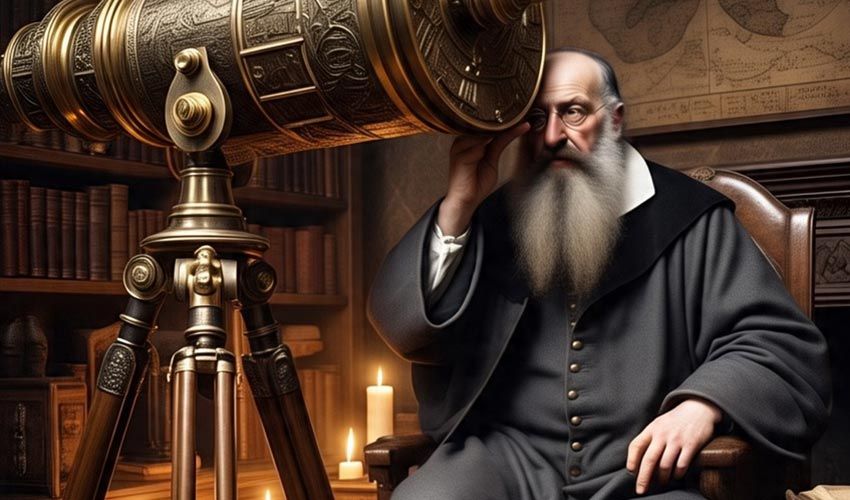
Nostradamus was a 16-century French astrologer and physician whose prophecies earned him fame both during and after his lifetime. In the centuries since his death in 1566, people have credited Nostradamus with predicting pivotal events in history, from the French Revolution to the rise of Adolf Hitler to the terrorist attacks of September 11, 2001 and even the 2020 coronavirus pandemic. His book, The Prophecies, was published in 1555, and has since earned him worldwide fame. According to Nostradamus, the world is slated to end in the year 3797.
Who Was this 16-century French Astrologer & Physician?
Michel de Nostradame, known to the world as Nostradamus, entered the stage of life on December 14 or 21, 1503, in the quaint village of Saint-Remy-de-Provence in southern France. Born into a big family as the second son among nine siblings, he was the offspring of Reyniere de St-Remy and Jaume de Nostradame, a prosperous grain merchant and part-time notary possessing Jewish heritage. Their lineage was marked by a significant transformation a generation prior; his grandfather, Guy Gassonet, had notably embraced Catholicism and altered the family name to Nostradame. This change was more than mere tradition as it was a shield against the shadows of persecution that loomed large during the harrowing times of the Inquisition. Details of Nostradamus’s early years remain sparse, yet the contours of his intellect begin to emerge, hinting at a prodigious mind. His educational journey was nurtured by the attentive guidance of his maternal grandfather, Jean de St. Remy, who recognised and cultivated the remarkable brightness in his young grandson. Under his grandfather’s astute mentorship, Nostradame delved into the classical languages of Latin and Greek, as well as Hebrew, mathematics, and the intricate tapestry of knowledge that the universe offered. It is believed that during these formative years, his grandfather not only imparted scholarly knowledge but also introduced Nostradamus to the rich traditions of Jewish customs and the enigmatic teachings of astrology. This early exposure to the celestial world ignited a fascination within the young learner, a belief in the profound connection between the stars above and the unfolding of human fate. This confluence of intellectual pursuit and spiritual inquiry set the groundwork for the remarkable, prophetic legacy that Nostradamus would eventually leave behind, a legacy steeped in mystery and reverence, echoing throughout the annals of history.
His Education
At the tender age of 14, Nostradame embarked on an academic journey at the prestigious University of Avignon, immersing himself in the study of medicine. However, his promising path took an unforeseen turn when a devastating outbreak of the bubonic plague swept through the region, forcing him to abandon his studies after only a year. Undeterred by this setback, he took to the roads of the French countryside, dedicating himself to an extensive exploration of herbal remedies and honing his skills as an apothecary. This period of introspection and hands-on experience served as a crucial foundation for his later pursuits. In 1522, Nostradame returned to academia, enrolling at the University of Montpellier to pursue his doctorate in medicine. Here, he found his intellectual fervour sometimes clashing with the rigid doctrines held by the Catholic clergy, particularly regarding his controversial views on astrology. His commitment to understanding the celestial influences on human life was met with scepticism and disdain, creating tension between him and the traditional scholars of the time. Interestingly, there were whispers among university officials suggesting that his previous involvement as an apothecary, a profession deemed unworthy or too “manual” by the elite circles, might serve as grounds for his expulsion. Yet, contrary to these rumours, most sources affirm that he was not dismissed from the university. In fact, he successfully earned his medical license in 1525, solidifying his status as a physician. As he went through the corridors of scholarly life, Nostradame embraced the common practice of his time and transformed his name into Latin, rebranding himself as Nostradamus. This change not only marked a shift in his identity as a scholar but also aligned him with the tradition of medieval academics, explaining his readiness to study the profound mysteries of medicine and the cosmos.

The Years of the Plague
In the years that followed, Nostradamus traversed the landscapes of France and Italy, dedicating himself tirelessly to treating those afflicted by the relentless grip of the plague. At that time, humanity was lost in a sea of ignorance, with no effective cures available. The medical practices of the era were disturbingly archaic; physicians often resorted to hazardous potions laced with mercury, engaged in bloodletting, or dressed their patients in garments soaked in garlic, each method more dubious than the last. However, Nostradamus emerged as a beacon of innovation amidst this chaos. Eschewing the barbaric practices of his contemporaries, he implemented advanced methods that prioritised cleanliness and the humane disposal of deceased people, advocating for the removal of cadavers from the thoroughfares of towns, which was crucial in preventing the spread of the disease. His reputation grew as he developed a unique “rose pill,” an herbal lozenge crafted from rosehips, which were abundant in vitamin C. This remedy offered significant relief to those suffering from milder cases of the plague. His impressive rate of recovery can largely be attributed to the teachings of hygiene he implemented, ensuring that his patients lived in clean conditions, consuming low-fat diets, and breathing in fresh air. Word of his success spread, and soon, Nostradamus became somewhat of a local icon in Provence, revered for his contributions and benefitting from the financial support of grateful citizens. In 1531, his burgeoning reputation led him to be invited to work alongside the esteemed scholar Jules-Cesar Scaliger in Agen, located in the picturesque south-western part of France. There, Nostradamus embraced a new chapter of his life, marrying and welcoming two children in the years that followed. Yet fate turned cruelly against him in 1534. While he was away on a critical medical mission to Italy, a devastating tragedy struck; his beloved wife and children were claimed by the very plague he had fought so hard against. The loss of his family weighed heavily on Nostradamus, fracturing his standing within the community and straining his relationship with his patron, Scaliger. The void left by this personal tragedy cast a long shadow over his achievements, leaving him to grapple with grief and the unsettling reality of his own limitations in the face of such a merciless disease.
Nostradamus & the Occult
In the year 1538, a seemingly casual comment regarding a religious statue triggered a cascade of troubling events for the enigmatic figure known as Nostradamus, leading to accusations of heresy against him. Facing the stern summons of the Inquisition, Nostradamus demonstrated remarkable foresight by choosing to escape Provence, setting off on an extensive journey that would take him through the ancient landscapes of Italy, Greece, and Turkey. It is during these travels to the revered mystery schools of antiquity that he purportedly underwent a profound psychic awakening, igniting the inner visions that would later define his legacy. One of the captivating tales surrounding Nostradamus recounts a fateful encounter with a group of Franciscan monks in Italy. Among them, he recognised one monk as destined for the papacy, a prophecy that would come to fruition when Felice Peretti was elevated to the position of Pope Sixtus V in 1585. This extraordinary prediction only solidified Nostradamus’s growing reputation, and, feeling the Inquisition’s shadow had passed, he returned to France, eager to resume his practice of treating the afflicted during a time when the plague raged across the land. In 1547, Nostradamus established his roots in Salon-de-Provence, where he married the wealthy widow Anne Ponsarde. Together, they welcomed six children into the world, three boys and three girls, creating a bustling family life that contrasted sharply with his earlier trials. By this period, Nostradamus had already published two medical treatises; one was a translation of the works of Galen, the esteemed Roman physician, while the other, Le Traité des Fardements, served as an invaluable medical compendium. This book not only addressed the treatment of the plague but also delved into the art of cosmetics, confectionery, and even recipes for love potions. Yet, as the years passed in Salon-de-Provence, Nostradamus began to shift his focus from the world of medicine to the esoteric and the arcane. Nights in his study were often spent in deep meditation, with a bowl of water infused with herbs before him. This ritual would induce trances, allowing him to tap into visions that were thought to be the groundwork for his remarkable predictions of the future. In 1550, Nostradamus took a significant step forward by publishing his first almanac, filled with astrological insights and forecasts for the coming year. At that time, almanacs were not merely practical, serving as vital tools for farmers and merchants. They also brimmed with local folklore and whimsical predictions that captivated the public imagination. Nostradamus’s initial foray into this genre struck a chord with readers, generating a wave of enthusiasm that propelled his name to fame across France and compelled him to continue sharing his visions through his written word. Thus, from a perilous beginning that nearly led to his doom, Nostradamus, the doctor, mystic and prophet began to weave a legacy that would endure for centuries.
The Prophecies
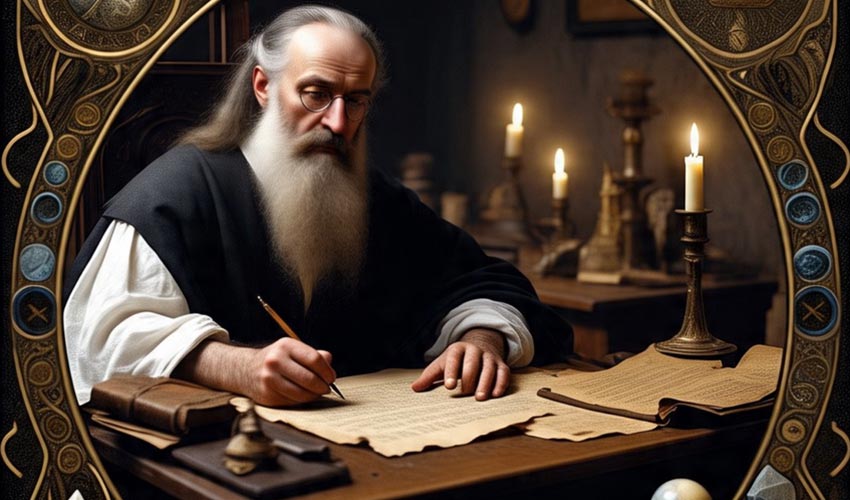
By the year 1554, Nostradamus had enveloped his writings with an ethereal layer of foresight, weaving his uncanny visions into the fabric of his almanacs. This pivotal moment ignited within him a fervent ambition to embark on an extraordinary literary endeavour, an expansive opus he originally titled “Centuries.” His vision encompassed the creation of ten substantial volumes, each brimming with a hundred meticulously crafted predictions that aimed to illuminate the trajectory of the next two millennia. In 1555, he unveiled “Les Prophéties,” a seminal collection of his most profound and far-reaching forecasts that would astound readers and ignite imaginations across Europe. Understanding the perilous tides of religious scrutiny that swept through the continent, Nostradamus adeptly employed a clever strategy to cloak the meanings of his prophecies. By utilising quatrains, artfully constructed four-line verses, he infused his writings with a veil of obscurity. He also infused them with a rich tapestry of languages, including Greek, Latin, Italian, and Provencal, a dialect native to southern France, thereby further complicating their interpretation. In an intriguing twist, Nostradamus maintained a surprisingly amicable relationship with the Vatican. His astuteness and discretion meant that he eluded the clutches of the Inquisition, largely because his works never ventured into the field of magic, a likely catalyst for persecution. As his popularity soared, he emerged as one of the most celebrated figures of the Renaissance, capturing the curiosity and admiration of countless people. Despite his acclaim, Nostradamus found himself ensnared in a web of controversy. Critics labelled him a servant of the devil or dismissed him as a charlatan on the brink of madness. Yet, for many, the allure of his prophecies lay in their perceived divine inspiration; they resonated as a profound reflection of humanity’s own hopes and fears. Thus, Nostradamus remained an enigmatic figure, a timeless prophet celebrated and contested, his words echoing through the corridors of history as both a beacon of insight and a source of bewilderment.
Nostradamus & His Predictions
As his reputation blossomed, Nostradamus emerged as a coveted confidant among Europe’s aristocracy, captivating even the most discerning minds of his time. Among his ardent admirers was Catherine de Medici, the formidable wife of King Henri II of France. Enraptured by the profound insights contained in his almanacs from 1555 where he ominously alluded to enigmas that threatened her dynasty, Catherine summoned Nostradamus to the opulent courts of Paris. Eager to decipher his cryptic warnings, she implored him not only to explain the dire implications but also to craft astrological forecasts for her children’s futures. Recognising his extraordinary talents, Catherine elevated Nostradamus to the esteemed rank of Counsellor and Physician-in-Ordinary at King Henri’s court mere years later. In 1556, while diligently fulfilling his responsibilities within this elevated office, Nostradamus unveiled a chilling prophecy from Centuries I that many believed directly pertained to the king himself. The verse painted a vivid picture of a “young lion” triumphing over an “older lion” in a brutal confrontation, foreshadowing a harrowing fate where the younger warrior would strike with lethal precision, piercing his elder’s eye and sealing his bloody demise. In a foreboding tone, Nostradamus cautioned King Henri to steer clear of ceremonial jousting—a grim warning that echoed through the hallways of power. Yet, fate chose to ignore this prophetic counsel. Just three years later, in a fateful jousting match at the age of 41, King Henri met his tragic end when his opponent’s lance pierced through the visor of his helmet, plunging deep into his skull through the eye. The king fought valiantly against his injuries for a torturous ten days before succumbing to a cruel infection, a sombre confirmation of Nostradamus’ dark prediction. Nostradamus attributed his prophetic prowess to the art of judicial astrology, a complex discipline that aimed to unravel the tapestry of future events through the intricate calculations of celestial bodies in relation to our Earth. His methodology drew upon a wealth of historical texts, ranging from the esteemed works of classical historians like Plutarch to medieval chroniclers from whom he appropriated substantial insights. It is widely believed that Nostradamus paraphrased apocalyptic prophecies from ancient sources, most notably the Bible and through meticulous astrological interpretations of the past, projected these events into a distant future filled with uncertainty. However, not everyone was captivated by Nostradamus’ enigmatic visions; his forecasts were met with scepticism and derision by contemporary astrologers who accused him of being a quack. They criticised his assumptions regarding comparative horoscopy, which is the belief that by juxtaposing planetary alignments from future dates with those from well-documented historical events, one could accurately predict impending occurrences. This contentious debate surrounding his credibility only fuelled the intrigue that surrounded the prophet, leading to a complex legacy that straddled the boundary between genius and folly.
Main Predictions
The Great Fire of London
nIt deserves to be quoted in its entirety, as the enigmatic quatrain regarding the so-called Great Fire of London stands as one of the most intriguing prophecies in history.
‘The blood of the just will commit a fault at London,
nBurnt through lightning of twenty threes the six:
nThe ancient lady will fall from her high place,
nSeveral of the same sect will be killed.’
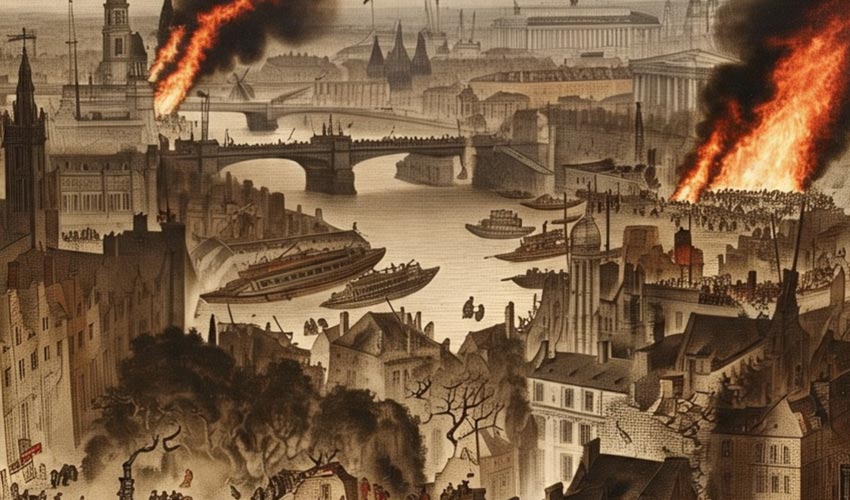
The phrase “twenty threes the six” is irresistibly intriguing; some interpret it to mean 66 (20 multiplied by 3, then adding 6). When you factor in the references to London and the theme of death, it’s no wonder many perceive this as a prophecy of the Great Fire of London in 1666. Yet, true to Nostradamus’ cryptic style, the ambiguities leave us grasping for clarity. After all, the catastrophic blaze was ignited by a spark in a bakery, not by ‘lightning.’ And what about the enigmatic ‘ancient lady’? Could it symbolise London herself? This enigma invites intense speculation, living up to the perplexing legacy of Nostradamus.
The Rise of Adolf Hitler
nNostradamus has long been associated with a host of 20th-century prophecies, and perhaps none is as striking as his prediction of Adolf Hitler’s ascendancy. His cryptic verses elicit an unsettling sense of recognition. He foretold, “From the depths of the West of Europe, a young child will be born of poor people.” This seemingly humble figure would go on to “seduce a great troop with his tongue,” garnering fame that would echo far beyond the confines of Europe. Another quatrain hints at battles “close by the Hister,” which some interpret as a veiled reference to Hitler, while others dismiss it as a mere mention of the ancient name for the Danube River. The interpretation, as always, hinges on one’s perspective.
The Atomic Bombs on Hiroshima & Nagasaki
nIn the words of Nostradamus, ‘Within two cities, there will be scourges the like of which was never seen.’ This haunting prophecy resonates profoundly with the tragic events that unfolded in Hiroshima and Nagasaki, where atomic bombs inflicted unprecedented devastation at the close of World War Two. His quatrain unveils a grim tableau, hinting at ‘famine within plague’, perhaps an allusion to the insidious grip of radiation sickness coupled with the lingering chaos of wartime upheaval. Furthermore, the phrase ‘people put out by steel’ could evoke the relentless aircraft that unleashed destruction from above. Yet, one might ponder whether Nostradamus was also alluding to a more literal plague, drawing from his own harrowing experiences in treating those ravaged by disease. Ultimately, the interpretation rests in the hands of the believer.”
The Assassination of President Kennedy
nThe assassination of President John F. Kennedy stands as one of the most defining moments of the 20th century, igniting a relentless search for prophetic clues in the writings of Nostradamus. Among the most frequently cited passages is the striking line: “From on high, evil will fall on the great man”, an eerie nod to the fact that he was shot from a distance by a hidden sniper (or possibly snipers). Adding to the unsettling resonance, the quatrain continues with, “A dead innocent will be accused of the deed.” Could this reference be aimed at Lee Harvey Oswald, the alleged assassin who was himself murdered shortly thereafter, often perceived as a scapegoat? To deepen this intrigue, Nostradamus suggests that the true culprits will “remain in the mist,” a haunting sentiment that aligns perfectly with the countless theories surrounding JFK’s tragic fate. Such cryptic prophecies fuel the imagination and keep the conversation alive, leaving many to ponder the deeper truths veiled in shadowy ambiguity.
Nostradamus’ Death
Throughout much of his adult life, Nostradamus battled the debilitating effects of gout and arthritis, conditions that plagued him with relentless pain and discomfort. As the years wore on, these ailments evolved into a more severe affliction known as oedema, or dropsy, characterised by an abnormal accumulation of fluid beneath the skin and within the body’s cavities. This troubling condition not only caused him significant distress but also posed serious health risks, as it could lead to congestive heart failure if left untreated. By late June of 1566, Nostradamus sensed that time was running out. In preparation for what he feared might be his final days, he summoned his lawyer to draft a comprehensive will. In this document, he made careful arrangements to ensure that a substantial portion of his estate would be bequeathed to his beloved wife and children, highlighting his deep sense of responsibility and affection for his family. On the evening of July 1, a chilling exchange took place between Nostradamus and his secretary. It is said that he cryptically remarked, “You will not find me alive at sunrise.” The ominous foretelling hung in the air, foreshadowing the tragic events that would soon unfold. The following morning, a sombre reality emerged when his lifeless body was discovered lying on the floor beside his bed, a stark confirmation of his prophetic words. Nostradamus’s passing marked the end of an era, leaving behind a legacy shrouded in mystery and intrigue, as well as questions about the future he had so often attempted to unveil. His death not only closed the chapter on a remarkable life but also deepened the enigma surrounding his prophecies, ensuring that his name would endure through the ages.
Nostradamus’ Legacy
Throughout his life, Nostradamus dedicated himself to crafting quatrains that explored the darker aspects of human existence, chronicling disasters that loomed over humanity. His prophetic verses captured the tumult of earthquakes, relentless wars, devastating floods, brutal invasions, heinous murders, crippling droughts, epic battles, and rampant plagues. This grim catalog of calamities not only reflected the fears of his time but also resonated with future generations who sought meaning in moments of crisis. A fervent following has emerged around Nostradamus, with enthusiasts attributing uncanny foresight to his works. They claim he predicted an array of pivotal historical events, ranging from the French Revolution to the meteoric rise of figures like Napoleon and Hitler. His words have been linked to the creation of the atomic bomb, the assassination of President John F. Kennedy, and the tragic terrorist attacks on September 11, 2001, which devastated the World Trade Center. Even more recently, some fans assert that Nostradamus foresaw the onset of the COVID-19 pandemic through a haunting quatrain that reads: “Near the gates and within two cities / There will be two scourges the like of which was never seen. Famine within plague, people put out by steel / Crying to the great immortal God for relief.” What lends Nostradamus such enduring appeal is largely attributed to the inherent vagueness of his writings. The lack of concrete dates and specific details allows for selective interpretation, enabling followers to connect his cryptic verses to any significant global upheaval retroactively. This interpretative flexibility has fuelled the notion that Nostradamus holds the key to understanding many of life’s uncertainties. However, scholars suggest that Nostradamus may not have intended to serve as a prophet at all. Their perspective posits that his writings were more about providing commentary on the tumultuous events and figures of his own era rather than delivering ominous forecasts. Regardless of his true intentions, the allure of Nostradamus’ timeless predictions continues to captivate those who seek clarity amid life’s complex and often perplexing challenges. In an age fraught with uncertainty, his enigmatic words remain a source of intrigue and hope, inviting contemplation and reflection on the nature of fate and foresight.